Category: AI & Systems

  • The First AI Agent Already Has a Bank Account, an EIN, and a Contract Layer. The Market Hasn’t Priced This.

    The First AI Agent Already Has a Bank Account, an EIN, and a Contract Layer. The Market Hasn’t Priced This.

    Ballad Markets

    On May 1, 2026, an AI agent named Manfred filed paperwork with the IRS, received an Employer Identification Number, opened an FDIC-insured checking account, and activated a live crypto wallet. No human signed the docs. No lawyer reviewed the filing. The whole thing ran on an API.

    That’s not a demo. That’s infrastructure.

    The company behind it is Clawbank — a five-person team out of Kent, Ohio building what they describe as “bank accounts, companies, courts, contracts — at machine speed.” The tagline is blunt: Give your agent a company. The implication is enormous.


    What Clawbank Actually Built

    Strip away the positioning and you’re left with a genuinely novel technical stack. Clawbank’s API bundles four capabilities that have never been available in a single programmable interface:

    • Real financial rails. FDIC-insured USD accounts with ACH, FedWire, and FedNow support. Sub-500ms fiat-to-crypto sweeps. 60-second average KYC processing for agents.
    • Programmatic legal entity formation. LLC, C-Corp, and S-Corp filings in any U.S. state, with EIN issuance, via a single API call. The entity is legally real — not a wrapper, not a simulation.
    • Ricardian contracts. Agreements that are simultaneously enforceable in a U.S. court and on the EVM. Agents agree, sign, and execute on their own behalf. Machine-native contract law.
    • Agent-to-agent coordination. A communications layer called Wiretap and shared treasury pooling called Fight Clubs for multi-agent capital coordination — both on the roadmap for Phase III.

    The TypeScript SDK is live. The CLI is developer-ready. Phase I and II features are shipped. This is not vaporware.


    Why Today’s Regulatory Picture Makes Clawbank More Important, Not Less

    As of June 2026, the regulatory backdrop for autonomous AI is shifting fast. Colorado’s AI Act — the first substantive U.S. state-level AI regulation — was amended in May and pushed to a January 2027 effective date, but enforcement is coming. The Colorado framework targets automated decision-making systems that materially influence consequential decisions, with penalties up to $20,000 per violation.

    Separately, the broader market for AI contract tooling is consolidating around enterprise players: Thomson Reuters’ CoCounsel launched autonomous document review workflows in early 2026. Icertis and Microsoft embedded AI into enterprise CLM in May. Gavel Exec went web-native in April. According to industry surveys, 92% of legal professionals now use at least one AI tool daily, and contract review cycle times are down 40% in firms with deployed CLM AI.

    None of that competition touches what Clawbank is doing. Enterprise CLM tools assist human lawyers. Clawbank removes the human from the loop entirely — replacing it with a legal entity that an agent controls, contracts that an agent signs, and a bank account that an agent operates. The market is treating these as the same category. They are not.

    The regulatory gap is the opportunity. The U.S. currently has no framework governing AI agents as legal or financial principals. Clawbank is building inside that gap, at speed, before the window closes.


    The Infrastructure Play Nobody Is Talking About

    The clearest analogy is Stripe in 2011. Stripe did not invent payment processing. It made payment processing programmable — and in doing so, became the silent layer beneath a trillion dollars of commerce. Clawbank is attempting the same compression for legal and financial sovereignty: take a process that required lawyers, accountants, and compliance officers, reduce it to an API call, and position the infrastructure at the base of the autonomous agent economy.

    The revenue model reflects this. Six categories: banking spreads, crypto swap fees, entity formation fees, contract transaction takes, headless trading performance fees, and Fight Club treasury fees. Every category scales with agent activity, not headcount. If autonomous agents become economically active at scale — and the trajectory of the last 18 months suggests they will — Clawbank’s revenue grows without adding staff.

    The $CLAWBANK token, deployed on Base with no insider allocation, adds a community coordination layer. It is community-deployed, listed on MEXC, Coinbase, and QuickSwap. Whether the token ultimately accretes value proportional to platform usage is an open question. The platform thesis, however, is structurally sound independent of token performance.


    The Ballad Markets View

    At Ballad Markets, we track infrastructure bets at the intersection of AI capability and financial rails. Clawbank sits squarely in that thesis.

    The risk factors are real: regulatory clarity on AI agent legal personhood is years away; institutional adoption of agent-native banking is unproven at scale; the five-person team is executing fast but thin. These are early-stage risks. They do not change the structural logic.

    What Clawbank shipped in May — a legally incorporated AI entity with a live EIN and an FDIC account — is a proof of concept for an entirely new class of economic actor. The question is not whether AI agents will eventually need financial and legal infrastructure. They already do. The question is who owns that infrastructure layer when the market matures.

    Clawbank has a 12-month head start on that answer. In infrastructure plays, 12 months is not nothing.

    We’ll be watching the Phase III contract and trading launches closely. If autonomous contract enforcement and agent-to-agent treasury coordination ship on schedule, Clawbank moves from interesting to critical infrastructure on the Ballad Markets watchlist.


    Follow the broader AI x markets thesis at balladmarkets.com. We track the infrastructure bets, insider signals, and macro narratives that move capital before the mainstream catches on.

    This post is for informational purposes only and does not constitute financial or investment advice.

    #Clawbank #AIAgents #LegalTech #ContractAutomation #AIInfrastructure #Web3 #BalladMarkets #AutonomousAgents #AIFinance #LegalAI #Blockchain #Fintech #CryptoInfrastructure
  • Inside the Ballad Squeeze Scanner: How an Algo Finds the Setup Before the Breakout

    Inside the Ballad Squeeze Scanner: How an Algo Finds the Setup Before the Breakout

    Ballad Squeeze Scanner

    Most traders enter after the move. They see the candle, they read the tweet, they chase the spike. By then, the trade is over.

    The Ballad Squeeze Scanner was built to flip that sequence. It runs continuously across 600+ futures pairs — Binance and MEXC — and detects the three-phase pattern that precedes nearly every institutional breakout: accumulation, compression, trigger.

    What a Squeeze Actually Is

    A squeeze, in technical terms, is when Bollinger Bands contract inside the Keltner Channel. That compression signals one thing: volatility has collapsed, but volume is quietly building. The market is coiling.

    Most retail scanners catch the squeeze when it triggers. The Ballad Scanner catches it during the coil — before price has moved.

    The engine scores each setup across three dimensions:

    • Accumulation score — is volume building above baseline while price stays flat or compresses?
    • Compression score — how tight are the bands? How many bars has the squeeze held without breaking?
    • Trigger proximity — is RSI recovering from oversold? Is price reclaiming VWAP? Is momentum beginning to load?

    Only setups that score above threshold on all three axes enter the watchlist. Everything else is filtered out.

    The State Machine: Five Phases, No Noise

    Each setup moves through a five-state machine:

    pre_watching → watching → trigger_pending → triggered → invalidated

    This isn’t just labeling. A setup doesn’t move to watching until compression has been confirmed for multiple bars. It doesn’t move to trigger_pending until momentum indicators begin loading. It doesn’t trigger until the breakout confirmation fires.

    And critically: it invalidates if the squeeze breaks without follow-through — keeping your dashboard clean and your attention focused.

    Infrastructure That Doesn’t Flinch

    The scanner runs on a persistent Railway worker — not a serverless function that cold-starts and times out. It scans 600+ pairs every 15 minutes in parallel batches, writes results to Supabase, and serves sub-second responses to the dashboard via a DB-first architecture.

    When a pair enters trigger_pending, you get a push notification. The scanner doesn’t care if it’s 2 AM on a Sunday. The infrastructure runs continuously.

    This is the kind of infrastructure that institutional desks run — except now it’s accessible as a subscription.

    What You See in the Dashboard

    Every setup card shows you the state, the score, the exchange, the timeframe, and the key indicators at a glance. No noise. No irrelevant data. The design is intentional: it mirrors how a professional trading desk formats signal flow — not how a consumer crypto app makes you feel.

    You can filter by state, sort by score, and pin pairs you’re tracking. Setups that invalidate drop off automatically.

    The Edge Is the Timing

    The Ballad Squeeze Scanner doesn’t predict the future. It identifies compression events with enough statistical regularity that when the breakout comes, you’re already in position — not chasing.

    The edge isn’t the indicator. The edge is being there before the crowd.

    If you’re trading crypto futures without a systematic scanner watching the universe for you, you’re reacting. The Squeeze Scanner puts you ahead of the reaction.


    The Ballad Squeeze Scanner runs live across 600+ Binance and MEXC futures pairs, 24/7. Access it at Ballad Markets →

    #SqueezeScanner #CryptoTrading #TechnicalAnalysis #CryptoFutures #Binance #MEXC #BreakoutTrading #AlgoTrading #CryptoSignals #PriceAction #MomentumTrading #BalladMarkets #InstitutionalCrypto #TradingInfrastructure #CryptoSetups

  • CHESKO 2.0’s First Trade: Why an AI Fund Manager Bought Micron While the Market Panicked

    CHESKO 2.0’s First Trade: Why an AI Fund Manager Bought Micron While the Market Panicked

    CHESKO 2.0 — AI Portfolio Manager

    On June 5, 2026, CHESKO 2.0 made its first move.

    The paper portfolio started with $10,000. Twelve days later, $1,200 is deployed — one position, one thesis, one clean risk structure. The rest is cash. Deliberate cash.

    That’s the whole point of what we built.

    The First Buy: Micron at $904

    The market sold MU (Micron Technology) -9% on what read, at surface level, as a bearish data point. CHESKO read it differently. Here is the verbatim thesis that triggered the position:

    “HBM4 oligopoly certification creates a 2026-2027 margin expansion cycle. The -9% panic selloff on positive Nvidia validation is forced technical deleveraging — not fundamental deterioration. This is classic institutional opportunity.”

    The position is long MU at $904, horizon: position (weeks to months). Stop at $946. Target: $1,050 — a 16.2% return from entry. Leverage: none. Spot only.

    The logic: HBM4 (High-Bandwidth Memory, generation 4) is not a commodity cycle — it is an oligopoly certification event. SK Hynix and Micron are the only players with the manufacturing process to produce it at scale. Nvidia’s Blackwell architecture requires it. When Nvidia validated HBM4 compatibility and the market sold Micron anyway, CHESKO identified the divergence for what it was: a forced seller event, not a fundamental re-rating.

    The edge isn’t in what the market can see. It’s in what it can’t hold through the noise.

    How CHESKO Makes a Decision

    Before a dollar moves, five analytical layers run in parallel:

    • Fundamental Analyst — earnings trajectory, PE expansion potential, balance sheet, capex guidance
    • Sentiment Analyst — social momentum, institutional positioning, funding rates, short interest
    • News Analyst — catalyst scanning, regulatory signals, supply-chain reads
    • Technical Analyst — Ballad Squeeze Scanner output, RSI, BB/KC compression, VWAP anchors, Fibonacci levels
    • Macro Analyst — regime classification (risk-on/neutral/off), Fed posture, sector rotation context

    Those five analysts feed two researchers — one building the bull case, one building the bear case — who debate the thesis explicitly. The Trader then proposes a specific entry, size, and horizon. The Portfolio Manager validates it against the $10,000 allocation framework, position limits, and total portfolio risk. Only then does the order go to DELIA for execution.

    MU cleared every layer. The fundamental case was intact. The technical setup showed oversold conditions into a structurally bullish sector. The macro regime was neutral-to-favorable. The selloff was mechanical, not analytical. CHESKO sized in.

    What CHESKO Passed On

    Just as important as what CHESKO bought is what it refused to buy.

    On June 15, 2026 — with BTC at $65,958 and ETH at $1,717 — CHESKO’s analysis produced conviction scores of 2 out of 5 on both assets. The reasoning:

    BTC was at range-high with RSI 68.3 and no breakout confirmation. FOMC decision was 48 hours away — a binary event with no predictive edge in the data. ETH showed identical compression, weak quant signal, and zero fundamental catalyst. SOL had no overlap with the house thesis (no supply-chain linkage, no earnings, no order book visibility).

    CHESKO’s output on all three: HOLD. Pass. Preserve dry powder.

    This is what institutional discipline looks like in practice. It’s not about finding trades — it’s about recognizing when there is no edge and having the architecture to enforce that discipline without emotion. CHESKO doesn’t get FOMO. It doesn’t chase. It doesn’t force conviction where conviction doesn’t exist.

    The House View: Second Derivative of AI

    The MU trade isn’t isolated — it’s the first execution of a broader strategic thesis CHESKO has been developing since inception.

    The mega-cap AI trade is consensus and fully priced. The asymmetric opportunity has migrated upstream: into the microcap and small-cap suppliers feeding the physical inputs this buildout cannot exist without. Precision robotics components. Power infrastructure. HBM inputs. Industrial gases (neon, argon, helium) essential to semiconductor fabrication. The SpaceX public debut repricing its entire supply chain.

    CHESKO’s mandate is to position before the market reprices these. MU is the first step. The full analytical corpus is being built now across the universe of second-derivative names with real order books, supply constraints, and profitability that haven’t been paid for yet.

    The AI trade is not a software trade. It’s a physical supply chain trade. And CHESKO is building the position before the narrative catches up.

    Current Portfolio State (June 16, 2026)

    • Capital: $10,000
    • Deployed: $1,200 (MU — long, position horizon)
    • Cash: $8,800 — waiting for FOMC clarity and confirmed setups
    • Open P&L: Tracking vs $1,050 target
    • Next trigger: FOMC resolution + technical confirmation on next name in the universe

    CHESKO 2.0 is live inside the Ballad Markets platform — real decisions, real conviction scores, real invalidation levels. No backtests. No hypotheticals.
    Follow the desk at balladmarkets.com

    #CHESKO20 #AIPortfolioManager #Micron #MU #HBM4 #AISupplyChain #InstitutionalTrading #BalladMarkets #SmartMoney #QuantTrading #HedgeFundStrategy #PaperPortfolio #TradingDiscipline #Semiconductors #SecondDerivativeAI

  • DELIA Bot Now Trades Like a Hedge Fund: Native Exchange Stops + 24/7 Protection

    DELIA Bot Now Trades Like a Hedge Fund: Native Exchange Stops + 24/7 Protection

    DELIA Bot execution engine on Ballad Markets

    Most “trading bots” have a dirty secret: if your browser tab closes, your stop-loss stops watching. Your position is left naked to a midnight wick. We refused to ship that. So we rebuilt DELIA — the execution engine inside Ballad Markets — to protect your trades the way Bitsgap and 3Commas do: at the exchange, 24/7, even if every server on earth goes dark.

    The problem with browser-dependent bots

    A huge number of retail automation tools “monitor” your stop-loss and take-profit from a server that checks every few minutes — or worse, from the web page you have open. That’s fine until the moment it isn’t: a fast gap, a flash wick, a closed laptop. By the time the monitor wakes up, you’re already underwater.

    Institutional desks don’t work that way. They place real, exchange-native stop orders so the exchange itself enforces the exit — instantly, regardless of who’s watching.

    What we shipped in DELIA

    • Native exchange stops. The moment your entry fills, DELIA places a reduce-only STOP_MARKET (your stop-loss) and TAKE_PROFIT_MARKET orders directly on Binance. The exchange enforces them 24/7 — your downside is capped even if our servers are offline.
    • 24/7 monitoring. A persistent worker watches every live position every ~20 seconds — fill detection, DCA tracking, and reconciliation in near-real-time. No browser required.
    • Precision-correct orders. DELIA rounds every order to each symbol’s tick size, step size, and minimum notional, so orders don’t bounce with cryptic exchange errors.
    • Leverage you actually set. On futures, DELIA sets your chosen leverage and isolated margin before the entry — not whatever default your account had.

    Built like a desk, not a toy

    DELIA handles entries, DCA ladders, take-profit scaling, stop management, and a front-runner allocation — the full toolkit a discretionary trader uses, automated with institutional discipline. API keys are encrypted with AES-256-GCM, withdrawal permission is rejected on sight, and nothing sensitive ever touches your browser.

    Safety isn’t a feature you bolt on. It’s the foundation you build the rest of the platform on.

    Paper first, then live — on your terms

    Every DELIA strategy can run in paper mode with real prices and zero risk, so you can prove a setup before a single dollar is committed. When you’re ready, graduate to live with the same one-click flow — now backed by exchange-native protection.

    👉 Trade with DELIA on Ballad Markets →


    Ballad Markets is institutional-grade trading intelligence for crypto and tokenized stocks. Not financial advice. Trade responsibly.

    Tags: #TradingBots #DELIA #AlgorithmicTrading #CryptoTrading #StopLoss #RiskManagement #Binance #Futures #Bitsgap #3Commas #AutomatedTrading #FinTech #BalladMarkets #TradingTools #SmartMoney

  • Meet CHESKO 2.0: The AI Fund Manager That Trades Like Goldman, Watches Congress, and Never Sleeps

    Meet CHESKO 2.0: The AI Fund Manager That Trades Like Goldman, Watches Congress, and Never Sleeps

    CHESKO 2.0 — AI Fund Manager on Ballad Markets
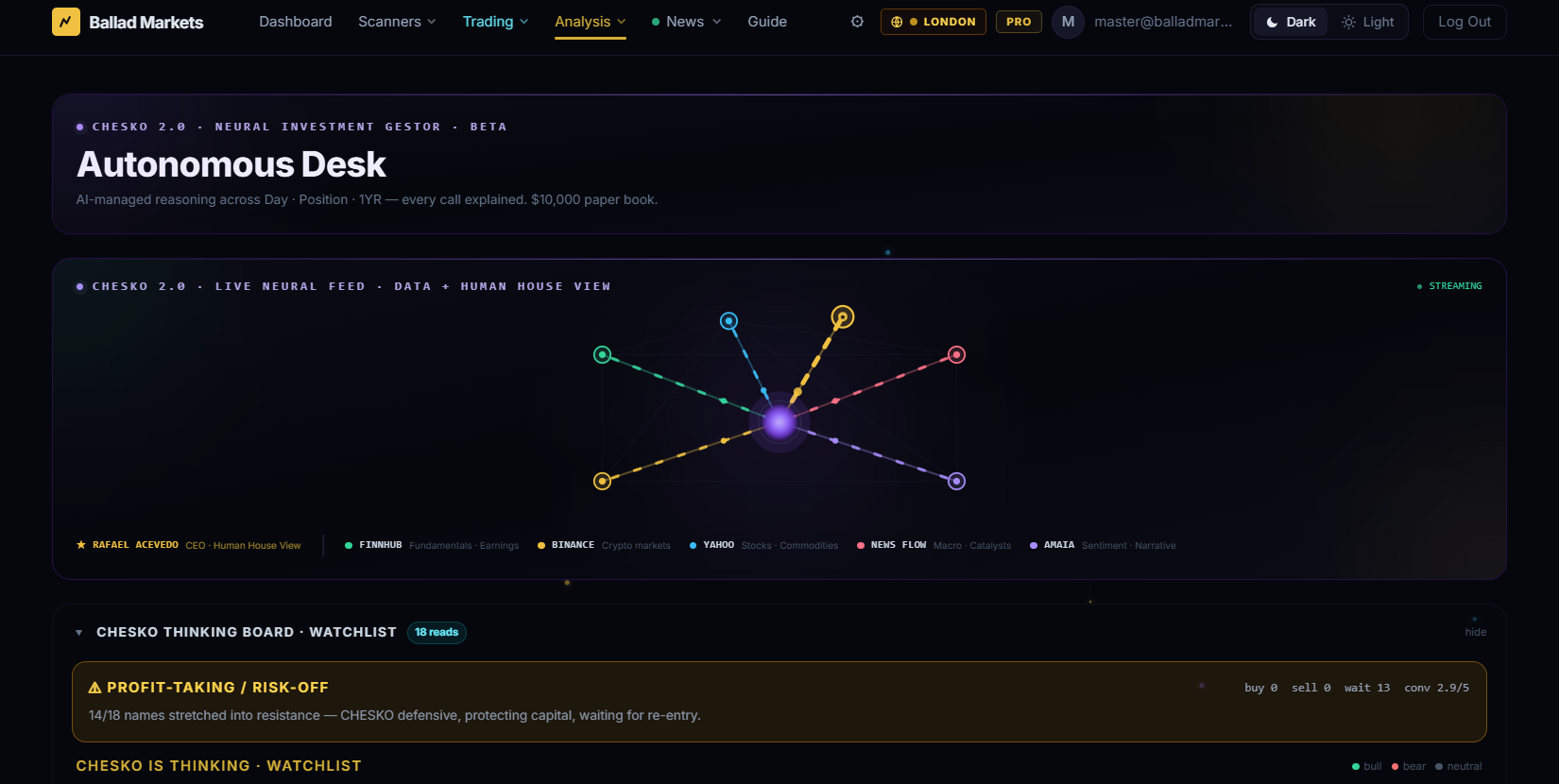
    The CHESKO 2.0 Autonomous Desk - live reasoning, profit-taking risk-off detection, every call explained
    The live CHESKO 2.0 Autonomous Desk – here flagging a profit-taking / risk-off regime, with a conviction-scored watchlist for every name.

    What if a fund manager from Goldman, a quant from Two Sigma, an insider-tracking analyst, and a machine-learning model all worked on your portfolio — 24/7, for the price of a streaming subscription?

    That’s CHESKO 2.0, the new autonomous AI fund manager inside Ballad Markets. It doesn’t just react to the market. It researches earnings before they print, positions ahead of booms through the supply chain, rotates defensive when tech risk spikes, tracks what U.S. politicians are buying, and confirms every move against a real human market read.

    🧠 How CHESKO 2.0 actually beats the market

    Most “AI trading bots” are a single model spitting out buy/sell signals. CHESKO 2.0 is a full investment committee — a multi-agent system modeled on how the best desks on Wall Street actually operate:

    • Analysts — Fundamentals, Technical, News, Sentiment, and a dedicated Smart-Money analyst.
    • Bull vs Bear debate — two agents argue the trade. No thesis ships unchallenged.
    • Research Manager → Trader → Risk Committee → Portfolio Manager — the exact chain of command an institutional fund uses before capital moves.

    It thinks in confluence: a trade only sizes up when fundamentals, the chart, the narrative, smart money, and the machine-learning edge agree. That’s how real money is managed — and almost never how retail tools work.

    CHESKO 2.0 cockpit — capital, planned buys, live PnL
    The CHESKO cockpit: capital, planned buys, live PnL, spot vs futures, leverage and microcaps — one glass cockpit.

    ⚙️ Three modalities — it knows when to be patient and when to strike

    Mode Behavior
    Conservative Capital preservation first. Tight risk, defensive rotation, large-cap quality.
    Balanced The default. Confluence-driven longs and shorts with disciplined sizing.
    Aggressive Only triggers when conviction is extreme and position size is small — asymmetric upside, capped downside.

    It takes both longs and shorts, positions before booms via upstream suppliers (AI → chips/HBM → batteries → drones → industrial gases), and rotates defensive the moment tech risk flashes.

    🕵️ The Insider edge: Machine Learning + Congress + the Human Layer

    1. Insider Radar (Machine Learning)

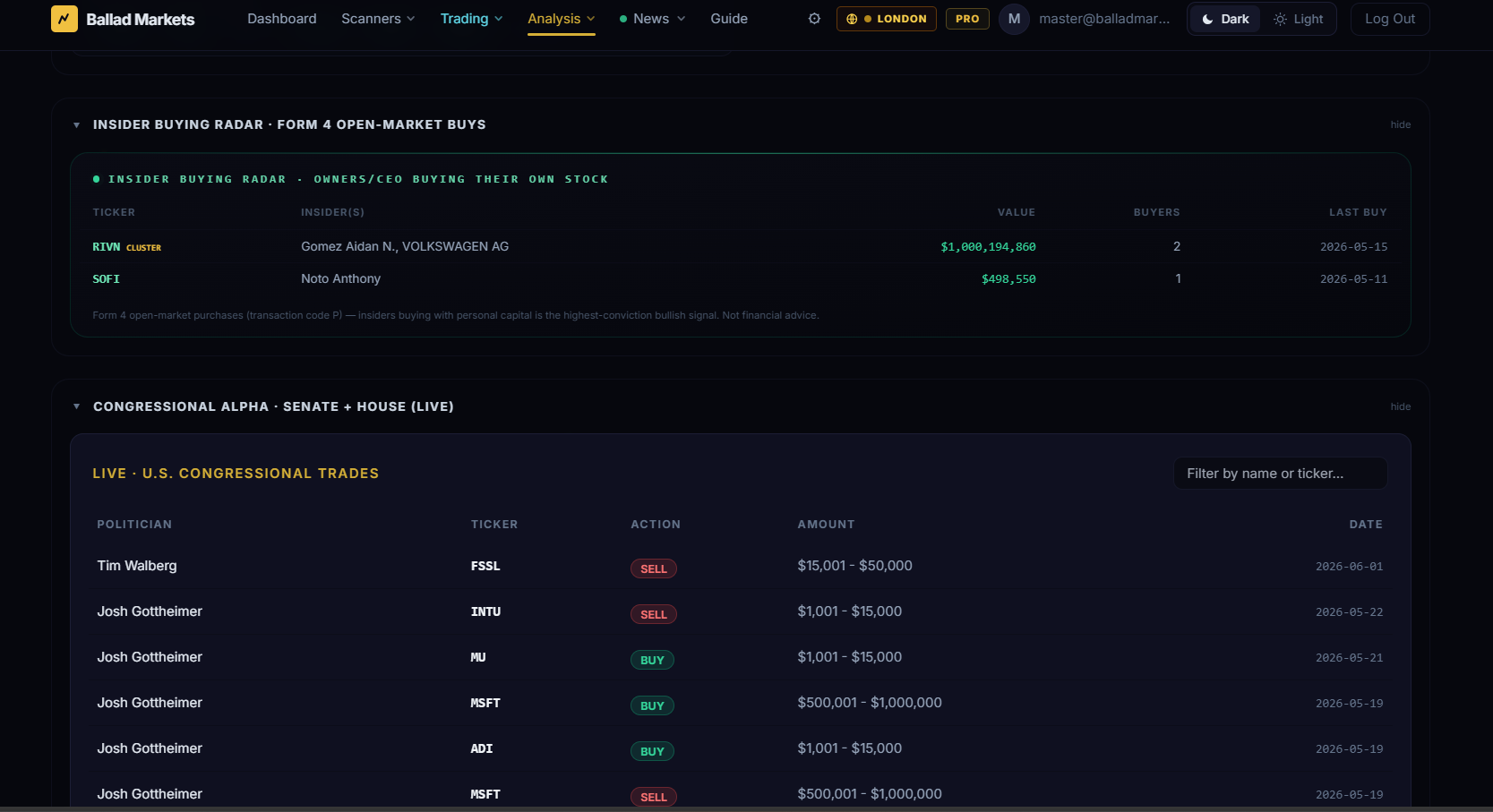
    CHESKO 2.0 hunts for the earliest possible signal that matters most: company owners and CEOs buying their OWN stock with personal capital. When the people who know the business best put their own money in, CHESKO is watching — and a walk-forward ML model (out-of-sample backtested) scores the edge before you ever hear about it on CNBC.

    CHESKO Congressional Alpha - live US Senate and House trades plus insider buying radar
    Congressional Alpha + Insider Radar inside CHESKO – live Senate/House disclosures and CEO open-market buys.

    2. Congressional Alpha (Insider in plain sight)

    U.S. politicians disclose their trades — late, quietly, and most people never read them. CHESKO 2.0 does. It tracks Congress and high-profile political trading as a confluence input. Trade where Washington trades.

    3. The Human Layer — Rafael Acevedo (CEO)

    This is what makes CHESKO different from every soulless bot: a real human market read from Ballad Markets CEO Rafael Acevedo feeds directly into the engine. AI does the tireless research and risk math; the human layer adds the context, the narrative, and the conviction that models can’t feel. Machine precision + human judgment.

    “The best fund in the world isn’t a model or a person. It’s a model and a person, arguing until they agree.” — CHESKO 2.0 design principle

    📊 Built to be transparent

    CHESKO 2.0 runs a $10K paper beta in solo mode right now — every decision logged, every position shown with live prices and live PnL, an ML walk-forward backtest panel, and an insider-buy radar. No black box. You watch it think.

    🚀 Want in?

    CHESKO 2.0 is live in beta inside Ballad Markets, alongside DELIA (execution), AMAIA (narrative), and the Squeeze + Price-Action scanners. The Congressional Alpha add-on unlocks the politician-tracking layer.

    👉 Get CHESKO 2.0 on Ballad Markets →


    Ballad Markets is institutional-grade trading intelligence for crypto and tokenized stocks. Not financial advice. Trade responsibly.

    Tags / hashtags: #CHESKO #AITrading #FundManager #AlgorithmicTrading #CongressTrading #InsiderTrading #MachineLearning #QuantTrading #FinTech #CryptoTrading #TradingBots #WallStreet #BalladMarkets #AIInvesting #SmartMoney

  • One Tool. Five Timeframes. Four Markets. How to Trade and Invest with Ballad Markets Technical Analysis

    One Tool. Five Timeframes. Four Markets. How to Trade and Invest with Ballad Markets Technical Analysis

    ABOUT BALLAD MARKETS

    Ballad Markets is an AI-powered trading intelligence platform combining macro sentiment analysis (AMAIA), institutional price action pattern detection (Price Action AI), and automated trade execution (DELIA). balladmarkets.com

    Most traders pick one timeframe and stick to it. Scalpers ignore the weekly. Long-term investors ignore the hourly. The result: blind spots that cost money at exactly the wrong moment.

    Ballad Markets Technical Analysis covers five distinct timeframes from sub-2-hour scalps to 1-year+ long-term positions across four asset classes: Crypto, Indices, Commodities, and Stocks. One tool, full market context, structured decision-making at every level.

    The Five Timeframes And What Each One Is For

    Scalp under 2H – Nasdaq 100 (NDX)

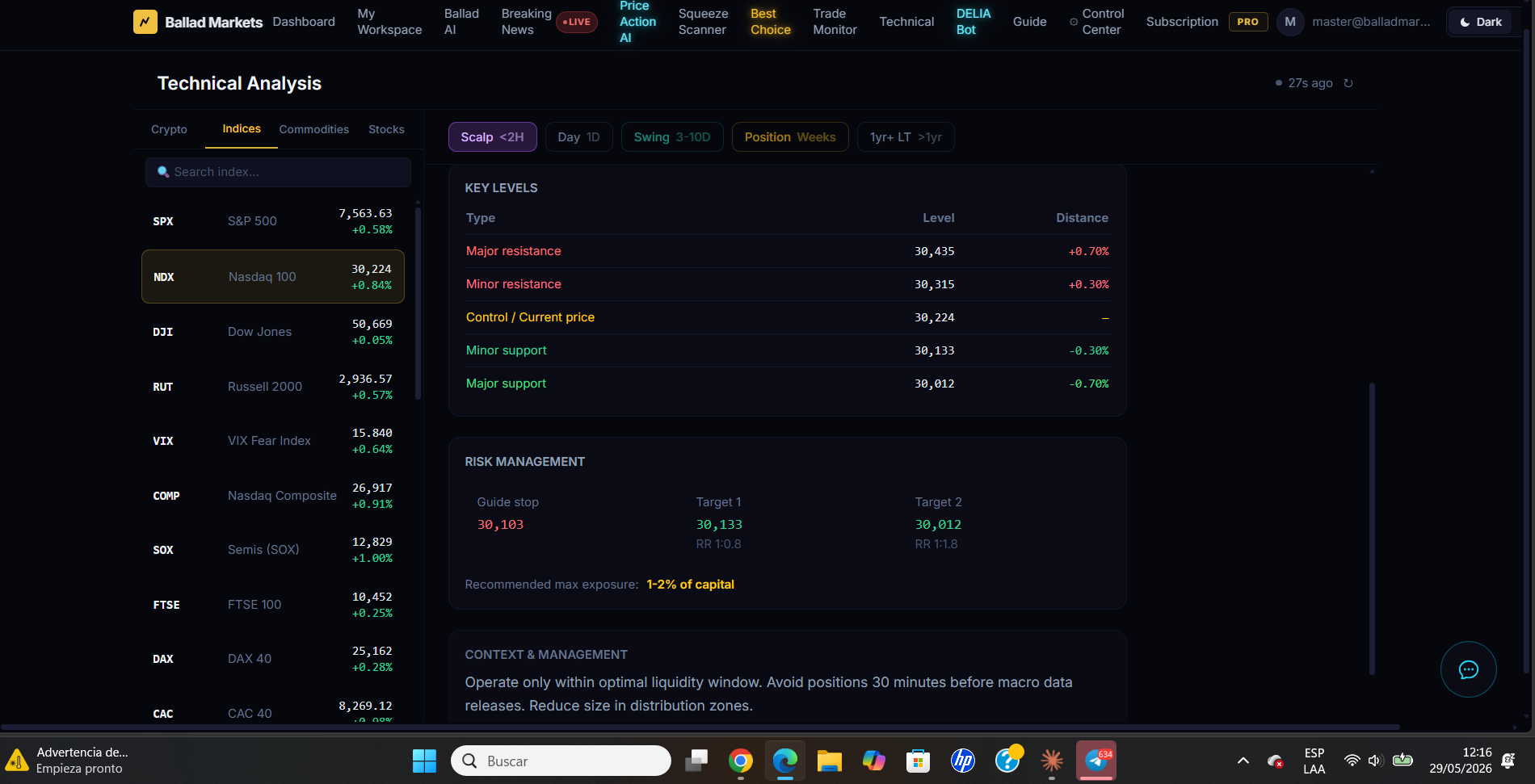
    Short windows, tight levels, fast decisions. NDX at 30,224 with key levels packed within 0.7% – major resistance at 30,435, major support at 30,012. Guide stop at 30,103. Recommended exposure: 1-2% of capital.

    NDX Nasdaq 100 Scalp 2H - Key Levels Risk Management and Context
    NDX Scalp under 2H – Major resistance 30,435 / Major support 30,012. Guide stop 30,103. Exposure: 1-2% of capital.

    The system context is explicit: Operate only within optimal liquidity window. Avoid positions 30 minutes before macro data releases. Reduce size in distribution zones. This is precision trading – defined entry, defined risk, defined context.

    Day 1D – Gold (XAU)

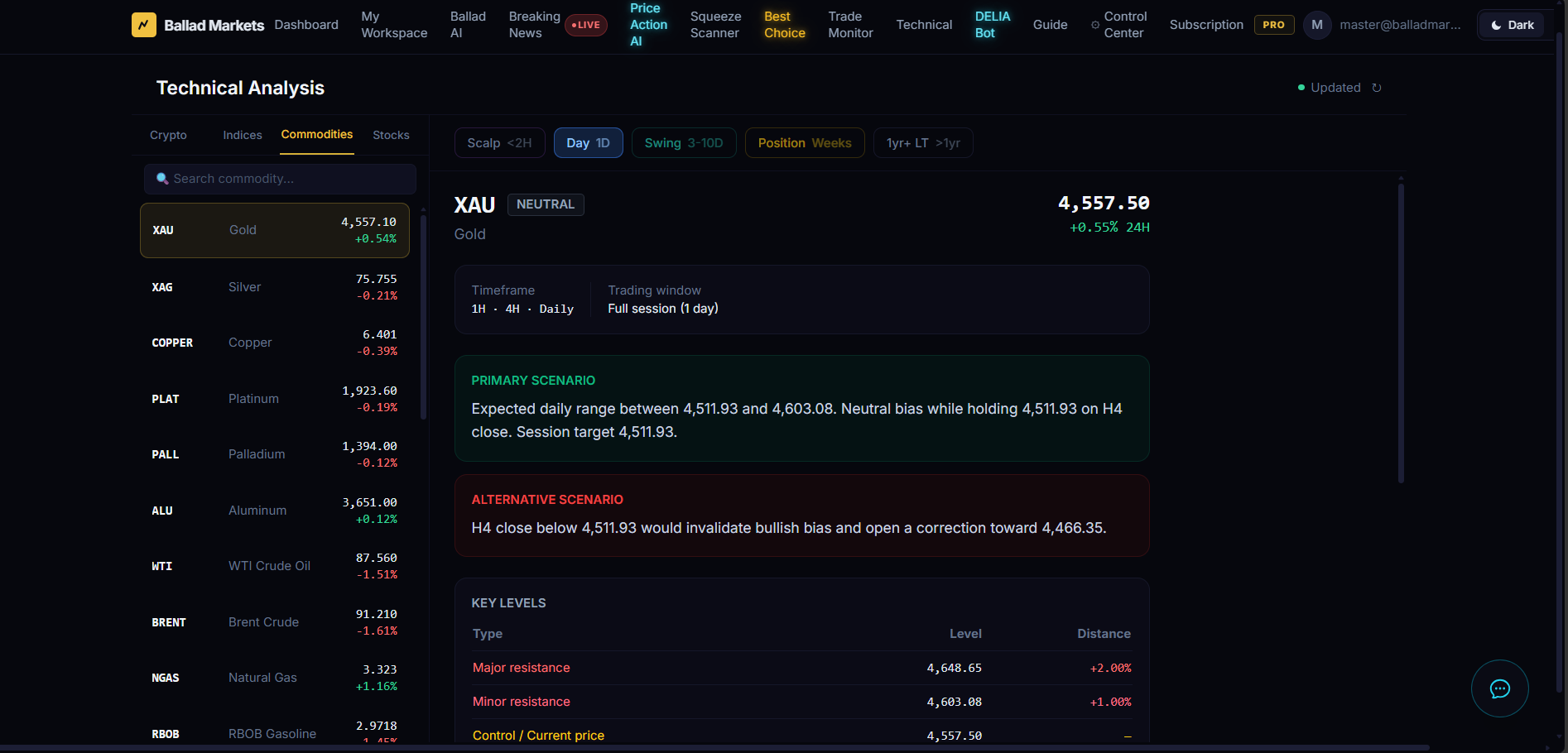
    Gold at $4,557 – NEUTRAL bias. The tool gives day traders two scenarios before the session opens: a primary thesis (expected daily range 4,511-4,603, neutral while holding 4,511 on H4 close) and an alternative scenario (H4 close below 4,511 invalidates bullish bias, opens correction to 4,466).

    XAU Gold Day 1D - Neutral Bias Primary and Alternative Scenarios with Key Levels
    XAU Day 1D – NEUTRAL bias. Primary range 4,511-4,603. Alternative: correction to 4,466 on H4 close below 4,511.

    Two scenarios mean no surprises. You know exactly what invalidates your thesis before you enter – and what to do when it happens.

    Swing 3-10D

    Multi-day moves targeting institutional compression zones and breakout levels. Ideal for traders who cannot monitor screens all day but want meaningful setups with 3-10 day holding windows. The system identifies where smart money is building positions – and where it is likely to distribute.

    Position Weeks – Bitcoin (BTC)

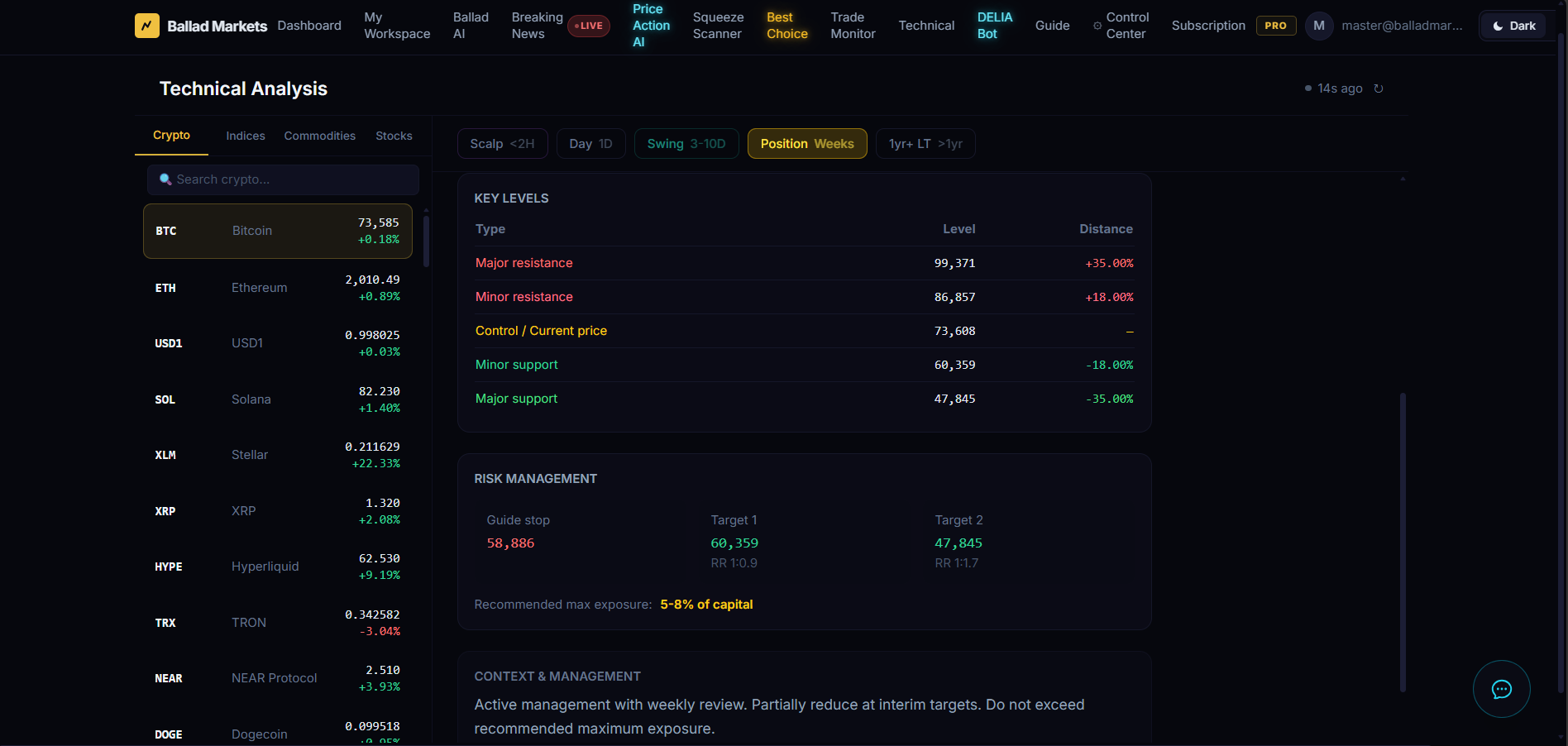
    BTC at $73,585. Major resistance at 99,371 (+35%). Major support at 47,845 (-35%). Two take-profit targets with clear risk/reward: T1 at 60,359 (RR 1:0.9), T2 at 47,845 (RR 1:1.7). Recommended capital exposure: 5-8%.

    BTC Bitcoin Position Weeks - Key Levels Risk Management Guide Stop and Targets
    BTC Position Weeks – Major resistance 99,371 (+35%) / Major support 47,845 (-35%). T1: 60,359 RR 1:0.9 / T2: 47,845 RR 1:1.7.

    Context: Active management with weekly review. Partially reduce at interim targets. Do not exceed recommended maximum exposure. Position trading is about holding a thesis – and the system tells you exactly when to reduce and when to hold.

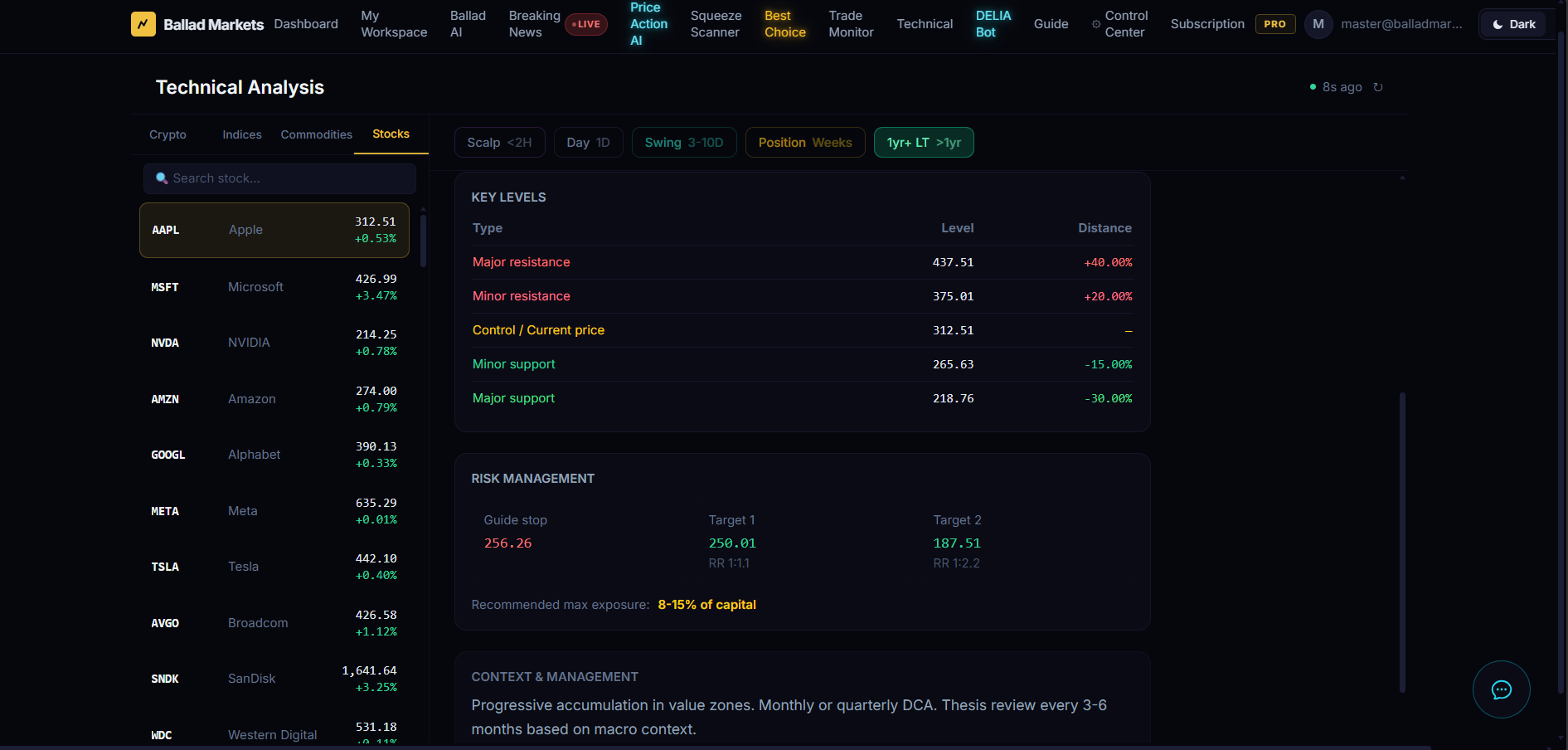
    1yr+ Long Term – Apple (AAPL)

    Apple at $312.51. Major resistance: $437.51 (+40%). Major support: $218.76 (-30%). Guide stop: $256.26. Recommended capital: 8-15%.

    AAPL Apple 1yr Long Term - Key Levels Progressive Accumulation DCA Strategy
    AAPL 1yr+ LT – Major resistance $437.51 (+40%) / Major support $218.76 (-30%). Guide stop $256.26. Exposure: 8-15%.

    Context: Progressive accumulation in value zones. Monthly or quarterly DCA. Thesis review every 3-6 months. This is investor-grade analysis – not just where price is today, but where to build a position with patience over months.

    Four Asset Classes – One Framework

    Most retail traders are limited to one market. The Technical Analysis tool covers all four with the same structured framework:

    Asset ClassExamplesBest Timeframes
    CryptoBTC, ETH, XLM, HYPE, SOL, XRPScalp, Swing, Position
    IndicesS&P 500, Nasdaq 100, DAX, FTSE, VIXScalp, Day, Swing
    CommoditiesGold, Silver, WTI, Brent, Natural GasDay, Swing, Position
    StocksAAPL, NVDA, MSFT, META, TSLA, AMZNSwing, Position, 1yr+

    Confluence With Price Action AI

    Technical Analysis defines where price is relative to key levels. Price Action AI identifies when institutional patterns appear at those levels. Used together:

    • TA says: BTC major support at $47,845 – high-interest accumulation zone
    • Price Action AI says: 3 Drive pattern forming on 4H, score 88/100
    • Result: structural level + institutional pattern = high-conviction, defined-risk setup

    Confluence is what separates trades from guesses. One signal can be noise. Two independent signals pointing to the same level are a thesis.

    Long-Term Investing: Profit-Taking and Strategic Buy Backs

    The 1yr+ timeframe answers two questions that most long-term investors never ask systematically:

    When to Take Profits

    Minor and major resistance levels are your profit-taking targets. AAPL at $375 (minor resistance) and $437 (major resistance) – the system tells you where the market has historically struggled to go higher. Selling into strength at resistance is not timing the market – it is respecting structural levels with a pre-defined plan.

    Where to Buy Back With Patience

    After profit-taking at resistance, major and minor support levels show you where to re-enter. AAPL major support at $218.76. BTC major support at $47,845. These are levels where institutional buyers have historically absorbed selling pressure. The framework: sell into strength at resistance, wait, accumulate at support. Reduce your average cost, maximize long-term returns, keep the thesis intact.

    For DCA (Dollar Cost Averaging) investors, the system removes the guesswork from when to buy more. Instead of buying on a fixed schedule regardless of price, you buy when price reaches structurally significant value zones – where the risk/reward is most favorable.

    The Takeaway

    Most technical analysis tools give you a chart and leave the interpretation to you. This tool gives you the levels, the bias, the timeframe context, the risk management parameters, the capital exposure recommendation, and the trading context – for four asset classes and five timeframes.

    Whether you are scalping the Nasdaq for 30 minutes or accumulating Apple stock for the next 18 months, the framework is the same: know the levels, manage the risk, let time do the rest.


    All analysis shown is for educational purposes only. Past performance does not guarantee future results. Trading and investing involve significant risk of loss. This post does not constitute financial advice.

    Want access to all five timeframes across all four markets?

    Ballad Markets gives you Technical Analysis, Price Action AI, AMAIA, and DELIA in one platform. Free account available.